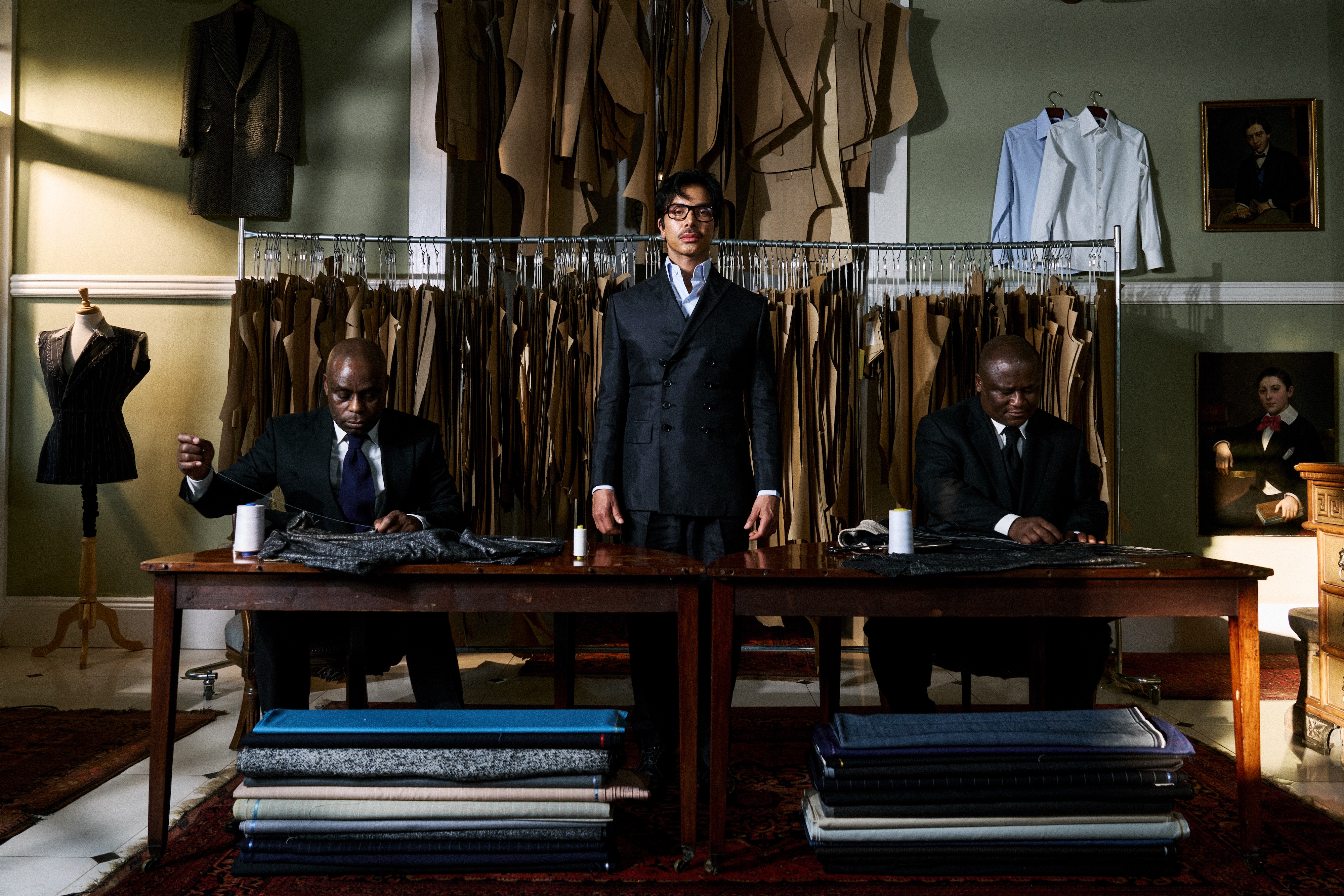
The Makers


The House is held in the hands of its makers.
Tailoring is a body of knowledge carried through practice. It lies in understanding figuration and balance; in knowing how a pattern must change for the body in front of you; in the manipulation of cloth through ironwork, canvas and hand; and in the fitting and correction through which a garment gradually finds its form. Alongside established systems of cutting and construction sits another kind of knowledge: the judgement acquired through years at the cutting board and tailoring bench, where the eye and hand learn what measurement alone cannot resolve.
At the House, this accumulated knowledge informs the Rahim Rawjee method of cutting: our own approach to proportion, balance and figuration, developed at the board and continually tested through fitting. It is grounded in the disciplines of traditional bespoke cutting and developed through their continued practice. Each pattern begins with a system, but is resolved through observation, judgement and what we call rock of eye: the cutter’s ability to read the individual figure and make the necessary departure from the system.
A Rahim Rawjee garment passes through very few hands. It remains close to those responsible for its making, from the first cut through successive fittings to its completion. Over the course of a commission, its cloth, its pattern and the body for which it is intended become familiar. This closeness matters. The cutter sees the consequences of the cut. The tailor sees how the cloth responds to construction. What is discovered at one fitting informs what happens at the next. Nothing is handed into anonymity.
Time is our collaborator. It is present in the years required to acquire a hand and in the attention given to a single garment. It allows cloth to settle, the eye to return, a fitting to reveal something previously unseen and a decision to be reconsidered. There are judgements in tailoring that become instinctive only after they have been made, tested and corrected hundreds of times.
At the heart of the House is the irreducible hand of the individual maker. Two makers may inherit the same traditions, work from the same pattern and use the same tools, but their hands are never entirely interchangeable. Experience, instinct and memory enter the work through decisions so small they may be invisible in isolation: the tension of a stitch, the manipulation of a seam, the pressure of the iron, the shaping of a canvas, the correction of balance.
The tradition may be inherited. The method may be taught. The pattern may be recorded. But the making remains irreducibly human.
Only the person who made it could have made it.
