
The Making
Making begins with knowledge.
Knowledge of cloth and how it behaves. Of proportion and balance. Of what can be measured, and what must be judged by eye. Knowledge learned at the board, passed from one pair of hands to another, and refined through years of cutting, fitting, unpicking and beginning again.The House draws upon traditions of tailoring considerably older than itself. British structure. Neapolitan softness. Generations of knowledge received and practised, carried across places and between makers, and given its own expression at the board in Johannesburg.We do not preserve these traditions simply because they are old. We preserve what remains true, question what does not, and add what experience teaches us.
This is the making: the accumulation of knowledge.
THE CUT
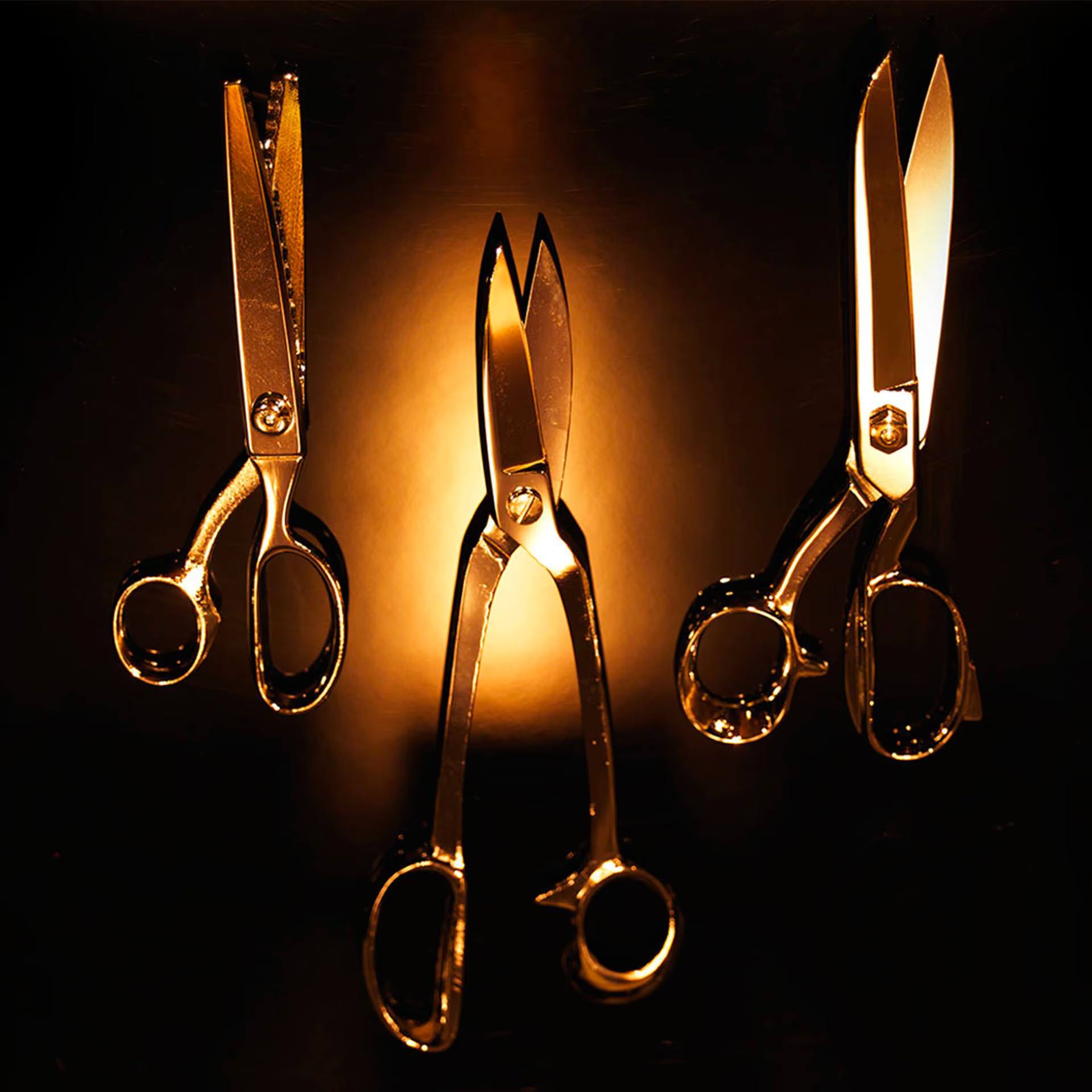
The cut begins with observation.
Before we draft a pattern, we read the body: posture and balance, the fall of a shoulder, the carriage of the arms, and the relationship between chest, waist and seat. Measurements provide coordinates, but they cannot determine proportion, nor can they prescribe beauty. These belong to the trained eye, what tailors have long called rock of eye: the ability to judge line, balance and proportion through experience and intuition rather than measurement alone.
How closely should the waist be suppressed? How much drape should remain through the chest to allow the lower torso to taper? Where should a jacket end to bring the body into balance? These are not measurements to be taken, but judgements to be made.
And the body is only one half of the conversation. The other is cloth.
Every cloth has its own character: weight, drape, resilience and movement. A soft cashmere asks to be shaped differently from a crisp worsted. We may allow the skirt to fall further so that a cloth can reveal itself in movement; draw the transition from chest to waist sharply in one cloth and more gently in another. We consider not only the line we wish to create, but what the cloth itself will permit.
Only then do we draft the individual paper pattern and commit the cloth to the blade. The pattern becomes a record of those decisions, returned to through successive fittings, corrected and refined as the garment reveals what neither measurement nor observation could know entirely in advance.
For the House, cutting is not simply the act of dividing cloth. It is the reconciliation of body, material and proportion through judgement.
THE CONSTRUCTION
The most important parts of a coat are often the ones its wearer will never see.
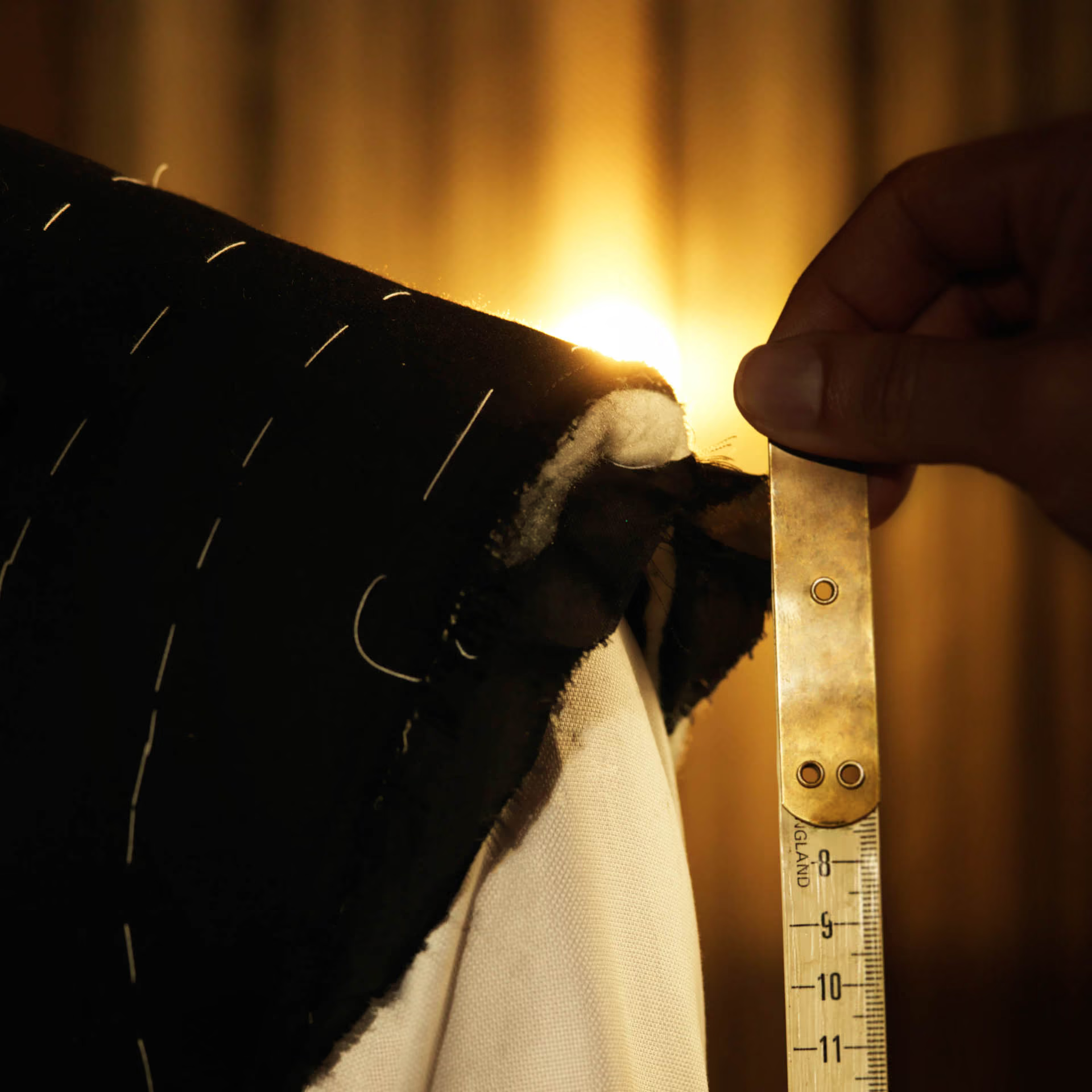
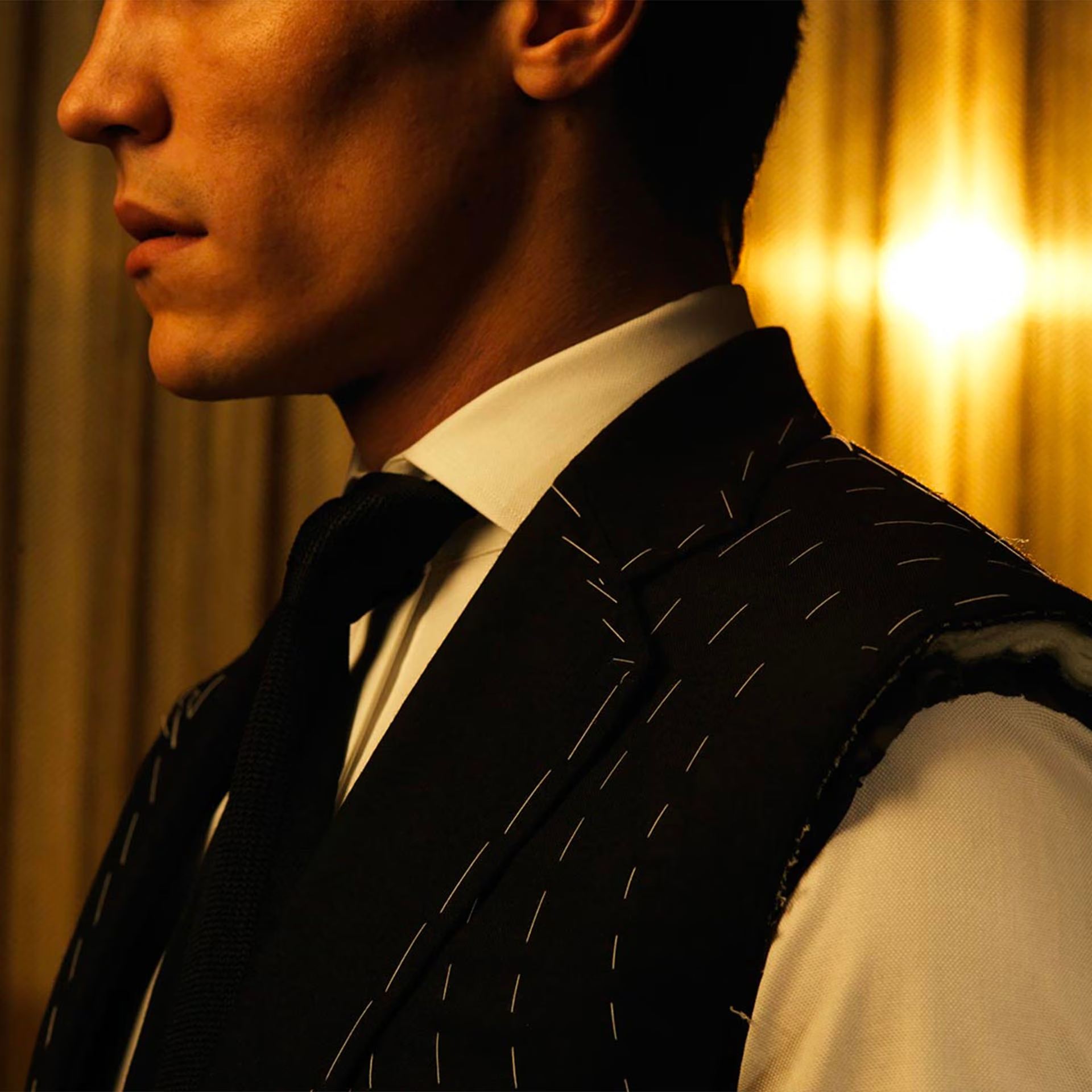
Beneath the cloth sits its architecture: a full floating canvas, cut and shaped by hand not simply for the garment, but for the person who will wear it.
The distinction matters. A floating canvas is not, in itself, the measure of a bespoke coat. Its purpose has always been to give the maker a structure that can be shaped to an individual body. The canvas is cut, darted, stretched and manipulated by hand, its shape developed specifically around the anatomy of its wearer. Volume is created where it is required and removed where it is not, establishing an internal architecture particular to that person.
The canvas beneath one client’s coat should therefore no more resemble another’s than their individual paper patterns do.
This shaping continues through the chest, shoulder and scye. Structure is introduced where it serves the line of the coat and allowed to recede where softness and movement are required. The internal architecture is inseparable from the decisions first made at the board.
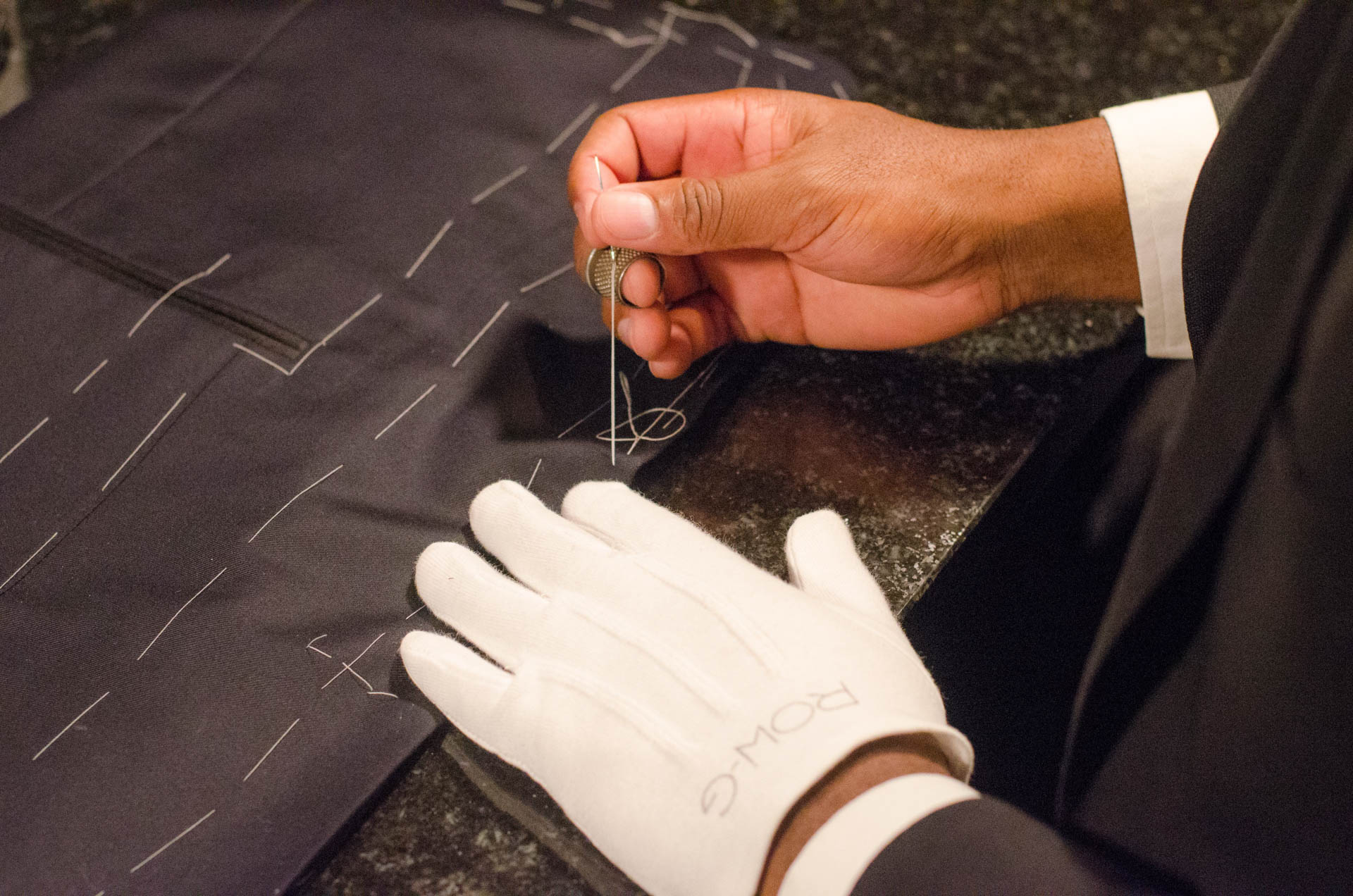
We leave generous inlays within the garment so that it can continue to accommodate its wearer over time. Linings are felled by hand. Collars are drawn on by hand. Sleeves are set by hand into the scye. Buttonholes are first cut and then worked by hand.
But handwork alone is not our measure of craftsmanship. A hand stitch has value only when there is a reason for it to be there.
Some stitches provide flexibility where rigidity would compromise movement. Some allow us to control shape with a precision a machine cannot. Others allow the garment to be opened, adjusted and returned to its wearer years later. Each technique survives within the House because it contributes something to the life, balance or beauty of the garment.
By the time a coat is finished, much of this work has disappeared from view.
Its presence is felt rather than seen.
THE HAND
Not everything we know can be written down.
Within the House, tailoring is learned in practice: at the board and at the bench, watching, repeating, correcting and beginning again. Knowledge passes between our makers not only through instruction, but through observation: the pressure of an iron, the tension of a thread, the way cloth is held, and the moment the hand knows to stop.
But the hand does more than remember. It gives physical form to thought.
There is a line we can see before it has been drawn; a shape we understand before it exists. Like a thought travelling from the mind, through the arm and into the pen before appearing on a page, the hand is the passage between what we imagine and what we make.
Within the House, this relationship between thought and hand is inherited through practice. Each maker carries something of those who taught them, adding the experience of their own hands to a knowledge considerably older than any one of us.
A machine can repeat an instruction with extraordinary precision. Our hands can respond. They feel resistance, accommodate irregularity, alter pressure and recognise when something requires reconsideration. Their intelligence lies not simply in what they can execute, but in their ability to judge while they work.
Over time, thought, knowledge and touch become almost indivisible.
The hand is where knowledge becomes form.
THE CLOTH
The making of cloth is a discipline unto itself.
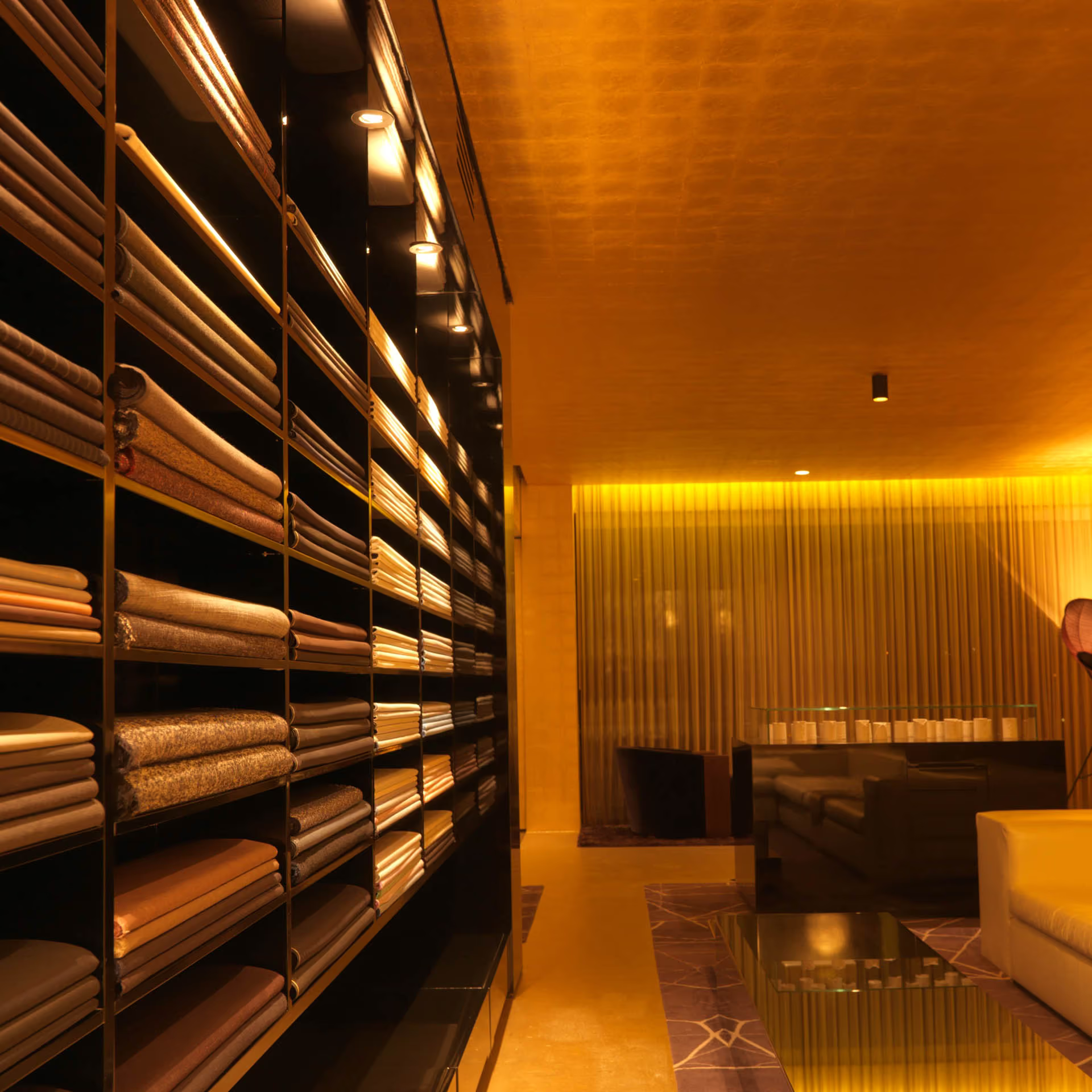
Long before a length of cloth reaches our board, other hands have already shaped its character. Fibre has been selected, spun, woven and finished by mills whose own knowledge has been accumulated over generations. Weight, handle, resilience, lustre and drape are not incidental qualities. They have been considered and made.
When that cloth enters the House, one discipline encounters another.
Within Rahim Rawjee, we think of this relationship as a conversation between cloth and maker. The finest cloth cannot compensate for an indifferent cut, poor balance or construction that fails to understand it. Put an exceptional cloth into the wrong hands and the very qualities that made it exceptional can be diminished.
The opposite is also true.
In knowledgeable hands, cloth can be allowed to become more fully itself. A flannel can settle and soften. A high twist worsted can hold a cleaner line and recover after wear. Cashmere can be given enough ease to move rather than being forced into rigidity. Mohair can be cut to exploit its natural sharpness and light.
This is why, within the House, we seek cloth of exceptional quality, but quality alone is only the beginning. We consider the garment it is expected to become, the body it will inhabit, the climate in which it will live and the life its wearer expects of it. Among the world’s finest cloths, the art lies in knowing which one will best express the garment we intend to make.
The great mill and the House therefore practise different disciplines, but neither exists entirely independently of the other. One creates the material. The other must understand how to release what has been placed within it.
At its best, the making of a garment becomes a dance between the two.
VEDANTA
Vedanta. From the Sanskrit veda, knowledge, and anta, end or culmination.
Within the House, the name speaks to knowledge brought to its fullest expression.
Vedanta brings together everything that precedes it: the trained eye of the cut, the architecture of construction, the intelligence of the hand and the character of exceptional cloth. Knowledge received across generations, practised and refined until it becomes instinct, then brought together for one person.
Nothing exists independently. The finest cloth requires the right cut. The cut relies upon construction. Construction depends upon the hand. And each must respond to the individual for whom the garment is being made.
Vedanta is not a collection, nor a level of embellishment. It is the House working at the fullest extent of its knowledge.
The accumulation of everything we know, in one garment.
